5 Item Geriatric Depression Scale: Scoring, Uses, and Limits
The 5 item geriatric depression scale is a very brief form of the Geriatric Depression Scale, often discussed as GDS-5. It is designed to help clinicians, care teams, and families notice possible depression symptoms in older adults when time, fatigue, or setting makes a longer questionnaire difficult. If you want a broader senior screening context before comparing versions, the free senior depression screening resource can help you review how GDS-style tools are usually framed.
This guide explains what the five item geriatric depression scale is, how scoring is commonly understood, when it may be useful, and where its limits matter. It is educational only. A short score can support a conversation, but it should not replace a full clinical review, especially when mood changes, safety concerns, memory changes, or major life stressors are present.

What Is the 5 Item Geriatric Depression Scale?
The Geriatric Depression Scale is a yes-or-no screening questionnaire created specifically for older adults. The original long form has 30 items. A widely used short form has 15 items. The 5-item version is a much shorter adaptation built from selected GDS questions that showed strong association with depression symptoms in validation studies.
The goal is practical: reduce the burden of screening while preserving enough signal to decide whether a more complete assessment is worth discussing. A frail older adult, a person who tires easily, or someone in a busy clinic may not always manage a 15- or 30-item form comfortably. A five-question screen can be easier to introduce.
Still, shorter does not automatically mean better. The geriatric depression scale 5 item version is best understood as a quick flag, not a complete picture. It may be most useful when the alternative is no screening at all, when a longer form is not realistic, or when staff need a brief first step before using the GDS-15, GDS-30, or a full mental health interview.
How the Geriatric Depression Scale 5 Item Version Is Scored
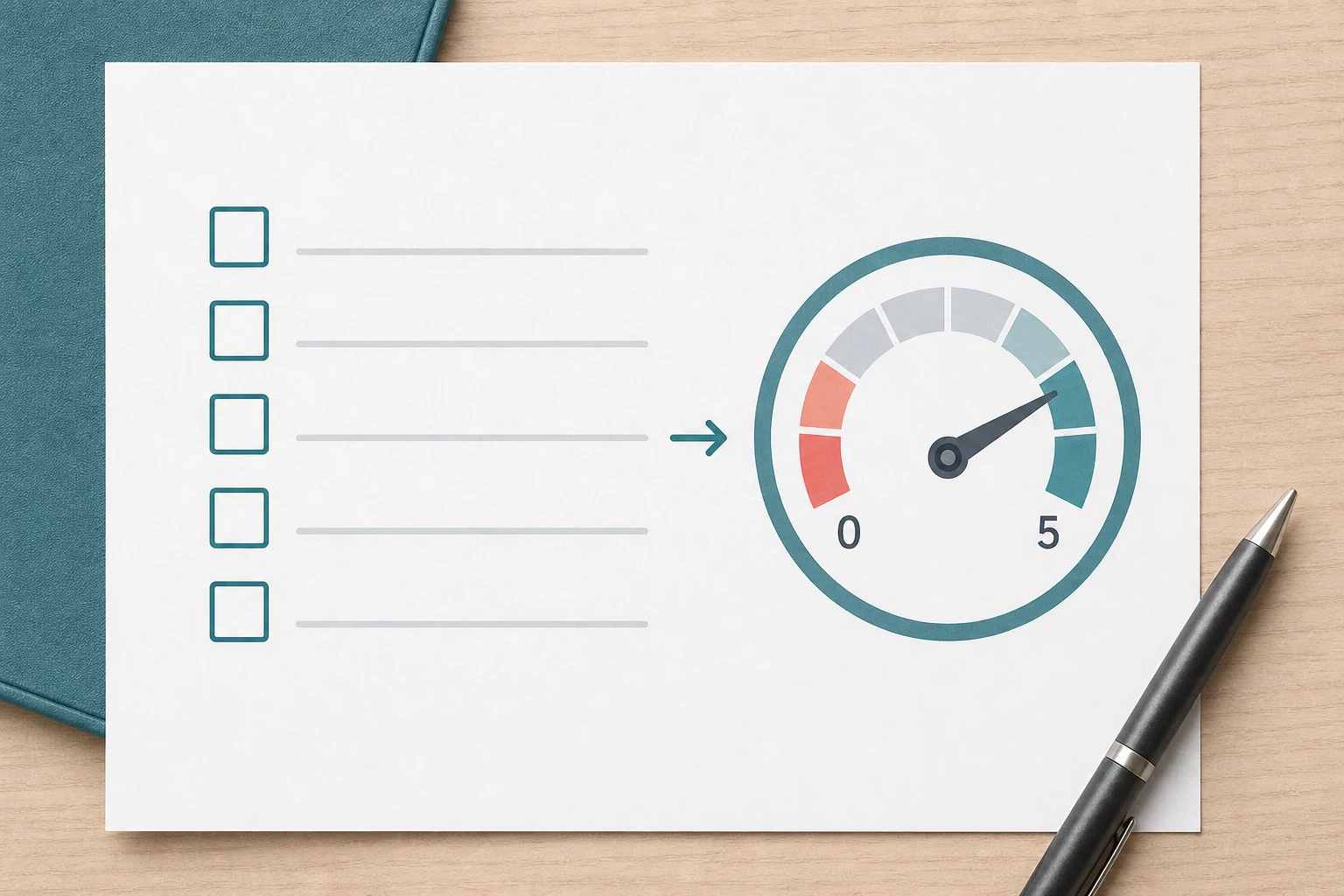
Most GDS formats use simple yes-or-no answers. Each answer is scored as either 0 or 1, depending on whether that response reflects a depression-related symptom. With a five-item version, the total score usually ranges from 0 to 5.
The basic calculation is:
- Ask each of the five selected yes-or-no questions.
- Assign 1 point for each depression-indicating answer.
- Add the points for a total score from 0 to 5.
- Interpret the result as a screening signal, not a final answer.
In many discussions of GDS-5, a score around 2 or higher is treated as a reason to look more closely. Some studies and settings use different thresholds, partly because there are multiple five-item versions and different populations. That is why the cutoff should be matched to the version being used, the setting, and the person’s health context.
For example, a score of 0 or 1 may suggest fewer endorsed symptoms on that brief screen, but it does not rule out depression if the person is withdrawn, grieving, medically ill, or reluctant to discuss feelings. A score of 2 or more often suggests that a longer tool or professional evaluation should be considered. A score of 5 means every depression-indicating answer on that specific five-item set was endorsed, so follow-up should be taken seriously and handled with care.
GDS-5, GDS-15, and GDS-30: How They Differ
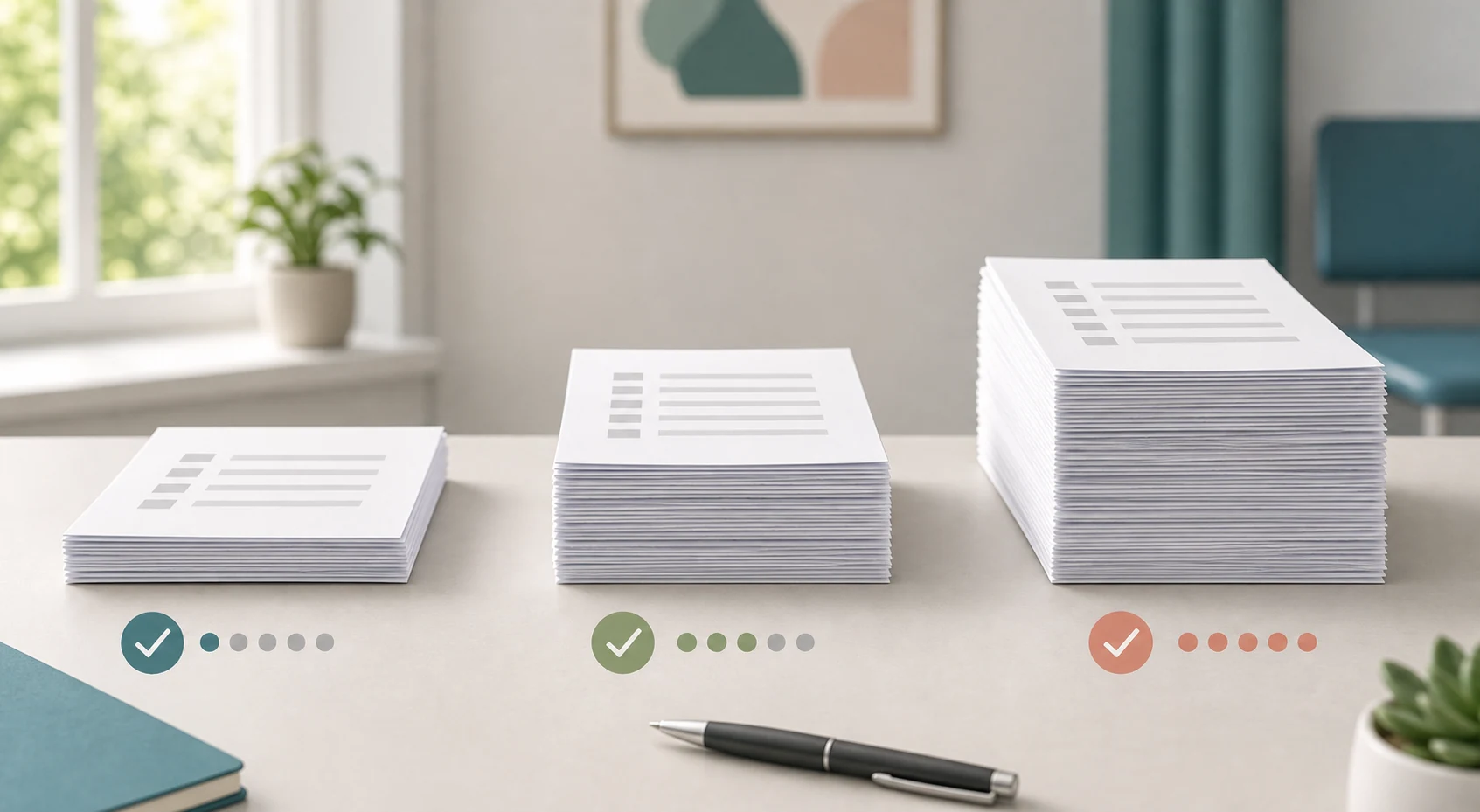
The 5 item depression scale is shortest. The GDS-15 is the common short form. The GDS-30 is the longer original form. All three are connected, but they serve different practical needs.
| Version | Typical length | Best fit | Main caution |
|---|---|---|---|
| GDS-5 | 5 yes-or-no items | Very quick first screen when time or fatigue is a barrier | Several versions exist, so scoring rules must match the chosen version |
| GDS-15 | 15 yes-or-no items | Common brief screening in care and community settings | A score near common cutoffs still needs context |
| GDS-30 | 30 yes-or-no items | More complete symptom screening when the person can tolerate it | Takes longer and may be harder for tired or medically ill adults |
The 15-item version is often easier to interpret because its scoring ranges are more commonly published. For GDS-15, many clinical education resources describe 0-4 as generally within a normal range, 5-8 as mild, 9-11 as moderate, and 12-15 as severe symptom range. The 30-item version is often interpreted across a wider 0-30 range, with higher scores suggesting more endorsed symptoms.
The five-item version compresses the signal. That makes it convenient, but it also means each answer carries more weight. One changed answer can shift the total score substantially. For that reason, a five-item result is often best used to decide what should happen next, not to label severity.
When a Five Item Depression Scale May Be Helpful
A five-question screen can be useful when an older adult is tired, physically unwell, or easily overwhelmed by long forms. It may also be helpful in home visits, senior living settings, primary care intake, or community programs where staff need a quick way to decide whether mood should be explored further.
It can also support caregivers. Many families notice changes before they know what those changes mean. An older parent may stop joining favorite activities, complain more often about sleep or aches, or seem less hopeful. A brief screen can turn a vague concern into a calmer conversation: “These answers suggest we should talk with your doctor,” rather than “Something is wrong.”
For people comparing online options, a private GDS screening starting point may be useful for learning how senior depression questionnaires are presented in a simple format. The key is to keep the tone supportive. Screening should feel like a health check-in, not a judgment.
What a Score Can and Cannot Tell You
A score can show how many depression-related answers were endorsed on a particular questionnaire. It can help track changes over time if the same version is used consistently. It can also give a clinician or caregiver a clearer starting point for discussion.
But a score cannot explain the whole person. Older adults may have grief, loneliness, medication changes, chronic pain, sleep problems, thyroid concerns, dementia, alcohol use, or major life transitions that affect mood and energy. Some people underreport sadness because they do not want to worry family members. Others describe emotional distress mostly through physical complaints.
This is especially important with very short tools. The GDS-5 may miss some people who need help, and it may flag some people whose symptoms are better explained by another issue. That is not a failure of the tool. It is the nature of screening.
Use these guardrails:
- Treat a higher score as a reason for a deeper conversation.
- Ask about recent changes in sleep, appetite, interest, memory, pain, and social connection.
- Share results with a qualified health professional when concerns persist.
- Seek urgent support if there are thoughts of self-harm, hopelessness with immediate risk, or unsafe behavior.
- Recheck over time with the same version when monitoring change.

How to Use a 5-Item Result in Real Life
The safest way to use a short GDS result is to pair it with observation and follow-up. A score is more useful when it leads to a clear next step.
Here is a simple action path:
- Write down the date, version used, and total score.
- Note what changed recently, such as sleep, appetite, activity, social contact, pain, medications, bereavement, or new illness.
- Ask the older adult what feels different in their own words.
- If the score is elevated or concerns remain, discuss it with a primary care clinician, geriatric specialist, or mental health professional.
- If possible, repeat the same version later only as a tracking aid, not as proof that everything is resolved.
For caregivers, the conversation matters as much as the number. Try language such as, “I noticed you have seemed less interested in things lately, and this short screen suggests it may be worth asking for support.” Avoid arguing over whether the person is “depressed.” Focus on comfort, functioning, and help.
For clinicians and care staff, document which five-item version was used. Because GDS-5 versions can differ, recording only “GDS-5 score” may not be enough. Include the source version, scoring threshold, and any relevant clinical context.
Choosing Between a Calculator, PDF, and Online GDS Tool
Searches for Geriatric Depression Scale PDF, Geriatric Depression Scale calculator, and Geriatric Depression Scale scoring often come from the same need: people want a fast, understandable way to score answers.
A PDF is useful when you need a printable record, a clinic workflow, or an offline option. A calculator is useful when you want fewer arithmetic mistakes. An online tool is useful when the user benefits from guided questions, instant scoring, and plain-language interpretation.
Whichever format you choose, use the same principles:
- Confirm which version you are using: GDS-5, GDS-15, or GDS-30.
- Check whether the scoring key belongs to that exact version.
- Keep answers private and share only with trusted care partners or professionals.
- Do not compare scores across different versions as if they were identical.
- Use the result to guide the next conversation, not to make a final judgment.
A Gentle Next Step After the 5 Item Geriatric Depression Scale
The 5 item geriatric depression scale can be a helpful first step because it is quick, simple, and less tiring than longer forms. Its strength is accessibility. Its limit is that five answers cannot capture the full story of an older adult’s mood, health, relationships, and daily life.
If you are exploring GDS options for yourself, a parent, or someone in your care, you can review a simple senior mood screening tool and use the result as a starting point for reflection. Bring persistent concerns to a qualified professional, especially when symptoms affect sleep, appetite, social connection, daily function, or personal safety.
Screening works best when it opens a calm conversation. The number matters, but the person behind the number matters more.

FAQ
What is a 5 score on the geriatric depression scale?
On a five-item version, a score of 5 generally means all five depression-indicating answers were endorsed. That is a strong screening signal and should lead to timely follow-up with a qualified health professional. It should still be interpreted with the exact version used and the person’s broader health context.
What is the geriatric depression scale?
The Geriatric Depression Scale is a yes-or-no questionnaire created for older adults. It screens for depression-related symptoms while avoiding some physical symptom questions that can overlap with aging or medical illness. Common versions include 30-item, 15-item, and very short forms such as GDS-5.
How do you calculate the geriatric depression scale?
You score each answer according to the scoring key for the specific version. Depression-indicating answers receive 1 point, and other answers receive 0 points. Add the points for the total score. The interpretation depends on whether you used GDS-5, GDS-15, or GDS-30.
Is the five item geriatric depression scale the same as GDS-15?
No. GDS-5 is a very short adaptation, while GDS-15 includes 15 questions and has more commonly published scoring ranges. GDS-5 may be faster, but GDS-15 usually gives a broader screening picture.
What is the depression scale for the elderly?
The Geriatric Depression Scale is one of the best-known depression screening scales designed for older adults. Other tools may also be used depending on setting, cognitive status, medical history, and professional judgment.
What are the 5 M's in geriatrics?
The 5 M’s in geriatrics usually refer to Mind, Mobility, Medications, Multi-complexity, and Matters Most. They are a broader geriatric care framework, not a depression scale. Depression screening often fits under “Mind,” along with cognition and emotional well-being.
Is geriatric anxiety scale 30-item scoring related to GDS scoring?
No. The Geriatric Anxiety Scale and the Geriatric Depression Scale measure different symptom areas and use different scoring systems. Do not use anxiety-scale scoring rules to interpret a GDS result.